


Alerts
The app alerts you when your spot's score reaches the level you choose and when aurora suddenly flares up on the mainland while your spot is dark and clear, and sends a forecast every day at 18:00.
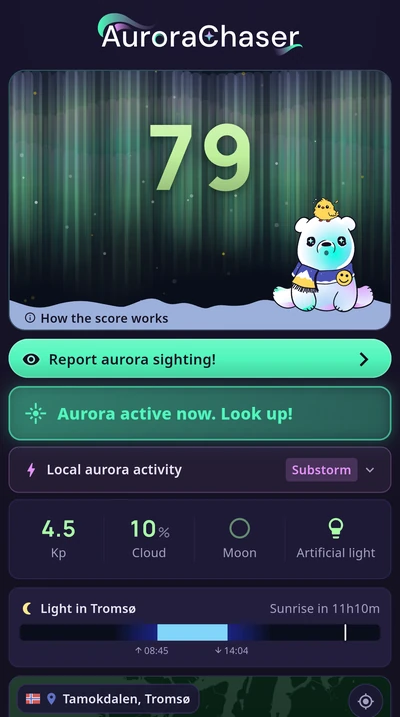
The app alerts you when your spot's score reaches the level you choose and when aurora suddenly flares up on the mainland while your spot is dark and clear, and sends a forecast every day at 18:00.
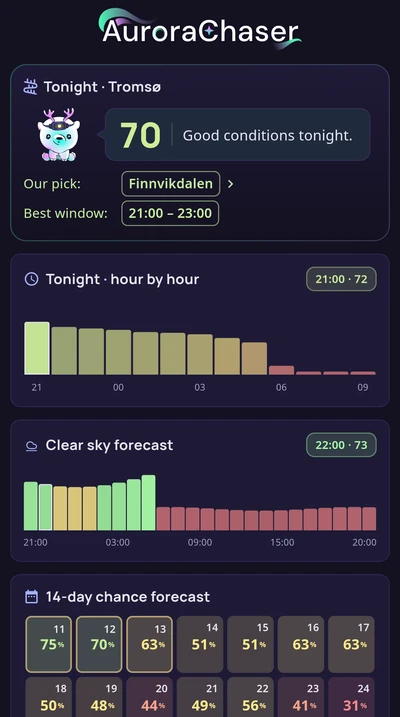
The Forecast tab shows tonight's peak score, best window and “Our pick” for your region, and your chance on each of the next 14 nights.
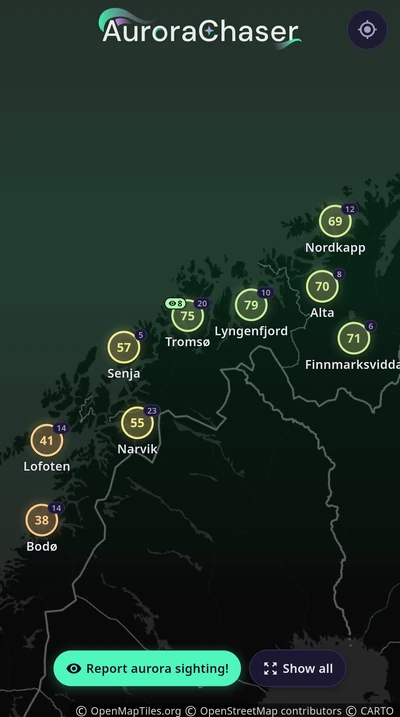
The map shows every spot's score and the auroral oval live, with drive times, tonight's last bus back where there is one, and live road cameras to check the road and the weather before you go.
Report a sighting with your photo, right away or the next morning, and see the community's photos and recent sightings at each spot.
Start a chase group for your trip with a shared feed and a group leaderboard, collect stamps and dress up your mascot.
In Northern Norway the aurora is often overhead even when the Kp index is only 1 or 2, so cloud and darkness decide more often than aurora activity. AuroraChaser gives each of its 128 viewing spots a score from 0 to 100 for every hour, and the app alerts you when your spot's score reaches 60 or the level you choose.
In Northern Norway the nights are dark enough for aurora between about 25 August and 17 April, depending on the region. On Svalbard they are dark enough from about 23 September to 19 March. In Tromsø the polar night lasts from 28 November to 14 January. Aurora activity tends to be higher around the equinoxes, in late September and March.
In Northern Norway and on Svalbard. Our forecast covers 128 viewing spots in 14 regions there, from Bodø in the south to Kirkenes in the east. In southern Norway only a strong geomagnetic storm, a few nights a year, brings the aurora low over the northern horizon. Each of our 14 regions has its own forecast page: Tromsø, Lofoten, Alta, Senja, Harstad, Narvik, Bodø, Kirkenes, Svalbard, North Cape & Hammerfest, Vesterålen, Lyngenfjord, Varanger and Finnmarksvidda.
Yes. The sun's 11-year cycle peaked in 2024–2025, and the Met Office says the years after a peak can often bring strong geomagnetic storms too. At these latitudes the aurora does not need a storm, so the solar cycle matters less here than further south.
Yes. AuroraChaser is a northern lights forecast made only for Northern Norway and Svalbard. The app is available for iPhone on the App Store and for Android on Google Play, in twelve languages: English, Norsk, Deutsch, Nederlands, Français, Español, Italiano, Polski, 简体中文, 繁體中文, 日本語 and 한국어.
Get an alert when it is worth going out, and see where others report aurora tonight.


The score uses live data from NOAA's Space Weather Prediction Center, MET Norway and FMI's IMAGE magnetometers, with light pollution from satellite night-light data. We fitted its numbers on all-sky camera records from the Nordic countries and North America and on archived weather data. The app also uses NASA DONKI for solar storm warnings, Statens vegvesen road cameras, Entur bus times and maps built from OpenStreetMap (all data sources).
AuroraChaser's aurora score is a number from 0 to 100 for one viewing spot and one hour. It combines how likely you are to see the northern lights with your own eyes and how bright they should be, so it is not a percentage.
A faint aurora that you are sure to see scores about 60. A phone camera picks up fainter aurora than your eyes can see, so a photo can show aurora while the score is low.
You will very likely see aurora, and the display should be bright. Go out once it is dark enough for aurora.
60–79GoodYou will likely see aurora with your own eyes, though it may be faint. It is worth going out.
40–59ModerateYou have about an even chance or better, and the aurora is usually faint or between clouds.
20–39PoorThere is some chance, mostly of a faint glow.
0–19Very poorThere is little chance, because the aurora is quiet or the sky is cloudy or too light.
Until the sky is dark enough for aurora (the sun 12° below the horizon), the score shows tonight's best hour, marked “Forecast”, unless the live score is already higher. After that, it shows the live score.
“Estimated” means the live aurora data or the weather forecast is missing, so part of the score rests on averages. Alerts pause until the data is back.
The score cannot see a gap in the cloud right above you, fog in your valley or lights close by, such as a headlamp or a lit house. It also does not know your eyesight or how long your eyes have had to adjust to the dark.
Read more about how the score works.